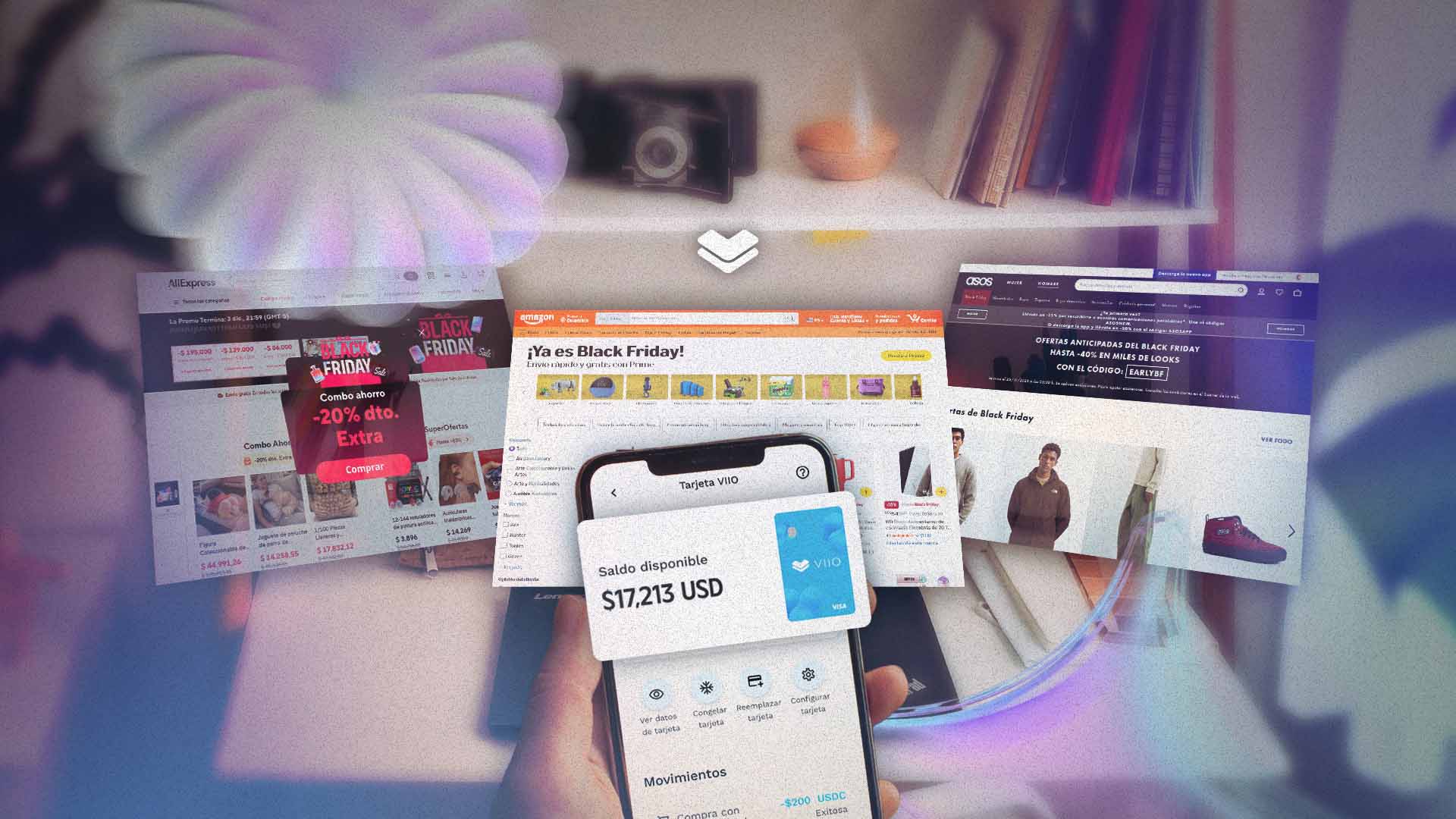
How to Shop on Amazon & ASOS from Colombia Without Overpaying

VIIO
Publish date: 11/25/2026
Last updated: 11/25/2026
The price you see on Amazon isn’t the price you actually pay.
For shoppers in Colombia, every international purchase goes through an invisible conversion layer that never shows up at checkout. The result: your cart said $200, which at an exchange rate of $3,100 COP should have been $620,000 COP—yet your bank statement shows $651,372 COP. The exact gap depends on your bank, the day of the purchase, and how many hidden fees get tacked on.
During Black Friday, international online shopping from Colombia surges—and so does the hidden cost of paying in dollars or euros with a Colombian card.
This guide breaks down why this happens, how to calculate the real cost, and what you can do to keep those extra fees in your pocket.
Why is your bank statement always higher than your cart total?
When a Colombian card processes a payment in US dollars, several things happen behind the scenes that the retailer never discloses at checkout:
- The exchange rate isn’t the actual market rate. Colombian banks use the official market rate (TRM) plus their own exchange rate markup, which typically ranges from 2% to 4%. This spread isn’t disclosed at the time of purchase and goes straight to the financial institution.
- Foreign transaction fees. Most debit and credit cards issued in Colombia charge an additional 1% to 4.5% on any transaction made in a currency other than Colombian pesos. This fee doesn’t always show up as a separate line item on your statement—in many cases, it’s simply baked into the final charge.
- The Financial Transactions Tax (4x1000). Colombia’s GMF (4x1000) tax applies to fund movements. On debit card purchases, it may be triggered depending on your account structure and bank. With a credit card, the 4x1000 doesn’t apply at the moment of purchase, though it can kick in when you pay off your credit card bill, depending on the funding account you use.
The bottom line: on a $200 USD purchase, these three costs can tack on significant extra charges without a single checkout screen ever warning you.
Which international stores are most popular for shoppers in Colombia?
The most popular international platforms for shoppers in Colombia include Amazon (US), ASOS (UK), AliExpress (China), and electronics retailers like B&H Photo and Newegg (US). Across all of them, prices are listed in US dollars, euros, or British pounds—automatically triggering currency conversion and the associated Colombian card fees.
What happens to your Black Friday discount when you pay with a Colombian card?
Black Friday brings genuine discounts across categories like electronics, apparel, software, and imported accessories. The problem isn’t the deal itself—it’s that a chunk of your savings gets eaten up by the cost of paying from Colombia with a peso-denominated card.
A 20% off item bought with a Colombian card that charges a 4% exchange rate markup plus a 2% foreign transaction fee leaves you with a real discount of roughly 14%, not 20%. On a $300 USD purchase, that difference works out to about $18 USD lost in payment processing without you even realizing it.
The discount is real. The question is who gets to keep a piece of it.
How to calculate the real cost of an international purchase from Colombia
Before hitting “buy” on an international order, you can estimate your true out-of-pocket cost using this formula:
Price in USD × (1 + exchange rate markup) × (1 + foreign transaction fee) × Exchange rate = Approximate real cost
- $3,100 × 1.03 (3% rate markup) × 200 = $638,600 COP
- $638,600 × 1.02 (2% transaction fee) = $651,372 COP
You end up paying $651,372 COP for something that could have cost you $620,000 COP.
Example based on a $200 USD purchase at an exchange rate of $3,100 COP.
To check the exact rates your bank charges, look up the fee schedule (tarifario) on your financial institution’s official website—this information is public and must be accessible before you sign up for or use the card.
How to cut the cost of shopping internationally from Colombia
Option 1: Pay with a USD account and linked card. If you hold a US dollar balance in a virtual account with a linked card, you can pay directly from that balance in the merchant’s currency—no conversion required at checkout. The amount on your statement matches your cart total to the cent. This method completely eliminates the exchange rate markup charged by Colombian banks.
Option 2: Control when you convert your money. Instead of letting your Colombian bank automatically convert your pesos at the exact moment you buy, you can top up a USD account when the exchange rate is in your favor and spend from that balance whenever you’re ready. You decide when to convert and at what rate—not your bank at checkout.
Option 3: Compare card fee schedules before Black Friday. Not all Colombian cards charge the same rates for foreign currency transactions. Some charge up to 3%, while others charge less. Every financial institution’s fee schedule is public—review yours ahead of time so you can pick the best card for international shopping.
Frequently asked questions about international shopping from Colombia
How much can I save on Black Friday by paying from a USD account? If your bank applies a 3% exchange rate markup plus a 2% foreign transaction fee, a $500 USD purchase will cost you $25 USD extra. By paying with a USD card instead, you bypass both the currency conversion and the foreign transaction fee.
Why does Amazon charge a different amount in Colombian pesos than the listed USD price? Amazon displays prices in US dollars on its platform. The final charge in Colombian pesos is determined by your card-issuing bank, which applies its own exchange rate—including a markup above the official market rate.
Can I avoid foreign transaction fees? Foreign transaction fees are charged by your card-issuing bank, not the retailer. To avoid them at checkout, use a card linked to an account that operates directly in the merchant’s currency—such as a card tied to a US dollar account.
What you can control when shopping abroad from Colombia
You don’t set the price tag on Amazon, ASOS, or any other international store. You don’t control the daily exchange rate either. What you can control is which account you pay from, which card you use, and when you convert your money.
With VIIO, you get a virtual account in the US (complete with a Routing Number) and in Europe (with an IBAN) to receive and hold funds in dollars, top up via PSE, and use a physical or virtual card to spend that balance directly at any international store—with zero maintenance fees.
This Black Friday, the discount you find is the discount you actually pay.
That’s the blue side of things.
Learn more at viio.me
Informational content prepared by the VIIO team. The fees and markups mentioned are reference ranges for the Colombian market as of the publication date. Exact values vary by financial institution and product. Check your bank’s official fee schedule before making international transactions. The reference market exchange rate (TRM) is published daily by the Banco de la República de Colombia at banrep.gov.co.