Foreigners and Digital Nomads: How to Manage Money in Colombia

VIIO
Publish date: 10/7/2026
Last updated: 10/7/2026
You arrive in Colombia with your passport, your laptop, and clients who pay you in dollars from another country. The first obstacle isn't finding a place to live; it's finding somewhere to put that money while you sort out your immigration status.
Editorial note: VIIO is one of the providers discussed below. The bank requirements come from each bank's official channels or specialized financial press, and the VIIO sign-up flow was tested first-hand, so you can verify everything independently before deciding.
The essentials, at a glance
In short: most large Colombian banks do accept a passport from a foreigner, but usually with friction: in-person opening only, balance and transaction caps until you have a foreigner ID card (cédula de extranjería), or, in Banco de Bogotá's case, apparently more than a passport alone. In the sources we reviewed, no bank offered a foreigner with only a passport a 100% digital process from day one. Digital accounts that verify identity with a passport directly are what people use in that gap.
The real problem: contrary to what many financial comparison guides say, most large Colombian banks do accept a passport as a valid document for a foreigner. The problem isn't that the door is closed; it's the experience: some only allow it in person at a branch, others cap your balance and transactions until you have a foreigner ID card (cédula de extranjería), and one bank in particular (Banco de Bogotá) does seem to ask for more than the passport alone. In what we reviewed, we did not find a bank that offers a foreigner with a passport a 100% digital process from day one.
Why this affects you if you come to work remotely: Colombia's Digital Nomad Visa (Type V visa, Resolution 5477 of 2022) gives you up to 2 years of legal stay, but the foreigner ID card (cédula de extranjería) is only processed after you arrive and register with Migración Colombia. During that initial period, you depend on what each bank allows you to do with a passport alone, which varies widely from one institution to another.
What people use in the meantime: digital accounts that verify identity directly with the passport, without requiring a foreigner ID card or Colombian proof of address from day one, and without having to visit a branch. VIIO explicitly positions itself for this audience, as the company itself has stated in outlets such as ENTER.CO since its launch.
What traditional banks actually require
We checked each bank's official channels directly (or specialized financial press, when the bank doesn't detail it on its own site) for what document it requires from a foreigner. The results are not uniform:
- Bancolombia: its own FAQ page accepts "visa, passport, or temporary foreigner ID card," meaning a passport works without a foreigner ID card. It does, however, also ask for "a second photo ID" and, depending on your profile, a supporting document (for example, an employment or university letter).
- BBVA Colombia: its official blog states that an adult foreigner can open an account by presenting a passport, but only by going to a physical branch. It is not available through the 100% digital channel that Colombian citizens with a cédula use.
- Banco Av Villas: its institutional blog explains that, in general, opening a savings account in Colombia requires documents such as "citizenship ID, passport, or foreigner ID document." This is a general explanation, not a bank-specific policy for foreigners, so confirm it directly with Av Villas.
- Davivienda: according to La República (September 2025), it is the most accessible: it allows "any visitor or resident from another country" to open a savings account "with only a passport."
- Banco de Bogotá: the exception. The same La República article says it allows foreigners to open a payroll account "with a foreigner ID card, passport, and visa," which suggests a passport alone is not enough. We did not find an official bank page that clarifies this, so treat it as the most restrictive on the list until you confirm directly with the bank.
What is consistent across all five is friction around the passport, not outright refusal: branch-only opening instead of 100% digital (BBVA's case), simplified accounts with low balance and transaction caps until you obtain the foreigner ID card, and policies that can vary from one branch to another depending on who serves you. It is worth saying plainly because several third-party guides (not the banks themselves) claim that "almost no bank accepts a passport alone," which does not hold up when you check Bancolombia's and BBVA's official pages.
This remains relevant for someone who has just arrived: even where a passport is valid, opening an account at a traditional bank almost always means going in person, waiting for an appointment, or being left with low limits until you obtain the foreigner ID card from Migración Colombia, a process that can only start after you have arrived in the country. It is in that window — passport in hand, ID card still in process — where a 100% digital account makes the real difference.
The Digital Nomad Visa (Type V), in brief
For people arriving to work remotely for clients or employers outside Colombia, the legal route is the Digital Nomad Visa (Type V), created by Resolution 5477 of 2022. Key points, per the Foreign Ministry (Cancillería) and updated 2026 guides:
- Valid for up to 2 years.
- Requires demonstrating, with bank statements, minimum income equal to 3 legal monthly minimum wages (SMLMV) over the last 3 months. With the 2026 minimum wage (COP 1,750,905), that is COP 5,252,715 per month, about USD 1,700 at the September 2026 TRM.
- Does not allow working for, or receiving payments from, people or companies domiciled in Colombia: it is for those who work for clients or employers abroad.
- Requires health insurance covering the entire visa period.
- Only available to passports from countries that already have visa-free entry to Colombia for short stays (US, Canada, European Union, UK, Australia, Japan, among others).
- After spending more than 183 days in Colombia within a 365-day period, you may become a tax resident with the DIAN (Colombia's tax authority), something worth reviewing with a tax advisor before it happens.
- Does not count toward Colombian naturalization.
VIIO and the audience it says it serves
VIIO did not arrive at this topic by chance. Since the launch of its digital dollar card, the company and its founders have publicly stated, in outlets such as ENTER.CO, that the product is aimed specifically at "digital nomads, remote workers, and expats."
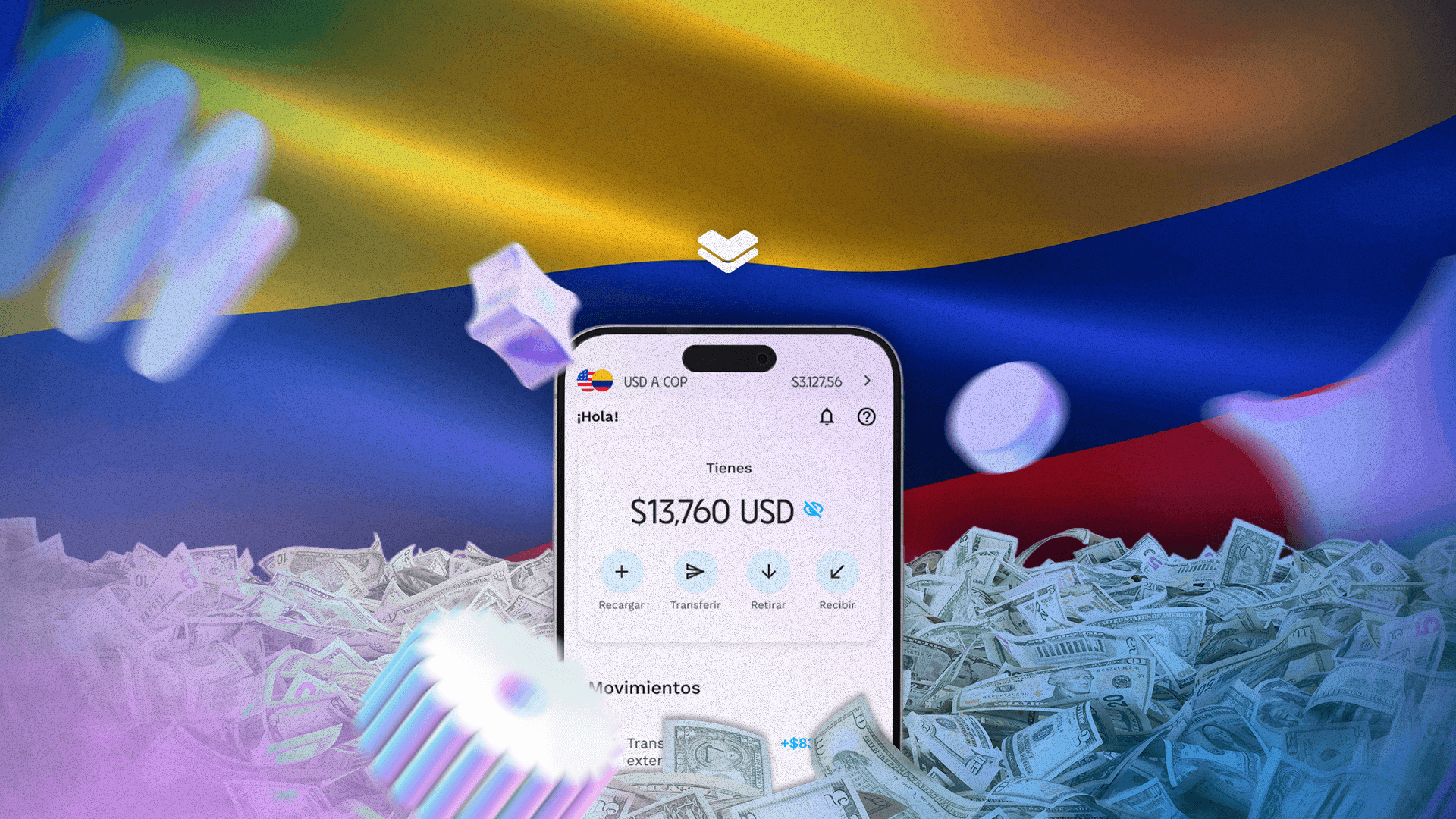
Confirmed first-hand by testing the app's sign-up flow: VIIO lets you create an account with only a passport, with no need for a foreigner ID card or Colombian proof of address, entirely online. VIIO accepts a Colombian ID or the ID document of your country of residence, a passport, a foreigner ID card (cédula de extranjería), or a PPT (Temporary Protection Permit). The difference is in the experience: sign-up is completed online, from your phone, without going to a branch or waiting for an appointment, and with fewer steps.
How other options compare if you don't have a foreigner ID card yet
We checked each platform's help center directly in September 2026. This is what each one states for signing up from Colombia:
- Littio: asks for your "identity document (cédula or passport)" and for you to choose your country of residence among Colombia, Argentina, Chile, Mexico, and Peru. A passport is valid.
- ARQ (formerly DolarApp): its help center mentions users registered with a Colombian citizenship ID, foreigner ID card, or passport, and it accepts peso top-ups with a cédula, foreigner ID card, PPT, or passport from any country.
- Global66: for Colombia, it only accepts an "ID card or foreigner ID card issued in Colombia." With a passport alone, you cannot yet open the account.
- Wise: lets you open a dollar balance without needing Colombian residency, since it operates as an international multi-currency account, not a Colombian bank account. Its card, however, is not yet available in Colombia: the app shows "Our cards aren't available in Colombia" and offers a waitlist (verified on a Wise account in Colombia, September 2026).
Each platform's requirements change; confirm them in its app before signing up.
Five things to sort out before you need the money
- Don't wait until you need the money to resolve this. If you know your foreigner ID card will take weeks, or that your preferred bank will require a branch visit, build your payment plan before you arrive, not after.
- Check whether your client or employer can pay you into a digital account without Colombian bank details. Most international payment platforms do not require the recipient to have an account in the country where they live.
- Keep proof of everything. Migración Colombia and the DIAN may ask for evidence of your income and of when you entered the country.
- Know when you cross 183 days. That is the point at which your tax situation in Colombia may change, and it's worth having it settled with an accountant before it happens, not after.
- Don't assume all fintech apps (or all banks) treat a newly arrived foreigner the same. Verify directly with each one which document it requires and whether the process is 100% digital, not just what its advertising says.
Frequently asked questions
Can I open a Colombian bank account with only my passport? At several large banks, yes: Bancolombia and BBVA confirm it in their own channels (Bancolombia also asks for a second photo ID), and Davivienda also accepts it according to specialized financial press. Banco de Bogotá appears to be the exception and ask for more than a passport. What changes between banks is the experience: BBVA, for example, only allows it in person at a physical branch, and several cap your balance or transactions until you have a foreigner ID card.
How long does the foreigner ID card (cédula de extranjería) take after the Digital Nomad Visa? That process is done after arriving in Colombia and registering with Migración Colombia; timing can vary. In the meantime, you depend on what each bank allows with only a passport.
Does the Digital Nomad Visa automatically make me a tax resident? Not immediately. It is triggered if you exceed 183 days of presence in Colombia within a 365-day period. Before approaching that limit, it is worth consulting an accountant about your obligations to the DIAN.
Do I need a Colombian bank account to receive payments from clients abroad? No. VIIO lets you create an account with only a passport, with no foreigner ID card or Colombian bank account, entirely online, as confirmed first-hand by testing the sign-up flow. Littio and ARQ also accept a passport according to their help centers; Global66, in Colombia, requires a citizenship ID or foreigner ID card.
Team note: this content is for informational purposes only and does not constitute immigration, financial, or tax advice. Visa, income, and account-opening requirements change frequently and may vary from branch to branch; confirm current information directly with Colombia's Foreign Ministry (Cancillería), with your chosen bank or platform, and with an immigration or tax advisor before making decisions.
Sources
- Bancolombia — What do I need to open an account for foreigners? (official page)
- BBVA Colombia — How to open a savings account step by step (official blog)
- Banco Av Villas — How savings accounts work in Colombia (official blog)
- La República — Some of the banks offering temporary account services for foreigners
- Cancillería — Visa types (Type V Digital Nomad Visa)
- Cancillería — Resolution 5477 of 2022
- 2026 minimum wage in Colombia: COP 1,750,905 (Decree 1469 of 2025)
- Littio — How do I create my Littio account? (help center)
- ARQ — What is a Bre-B key? (help center)
- ARQ — Top up my account with Colombian pesos (help center)
- Global66 — Identity document review (help center)
- Wise — Requirements to open a bank account in Colombia as a foreigner
- Colombia Move — How to open a bank account in Colombia (2026)
- Emergencias Jurídicas — How to open a bank account in Colombia as a foreigner
- Genki Guide — Colombia digital nomad visa 2026: rules, cost, how to apply
- Expat Group — Colombian Digital Nomad Visas, 2026 update
- Medellín Lawyer — Colombia Digital Nomad Visa 2026: Requirements & Steps
- Stanford Baker Blog — Colombia Digital Nomad Visa 2026: Complete Requirements
- ENTER.CO — VIIO and Visa launch a digital dollar card in Colombia for digital nomads, remote workers, and expats
- Golden Harbors — Colombia Digital Nomad Visa: nationality and naturalization requirements
- Lawzana — Securing a Colombian Digital Nomad Visa: 2026 Legal Guide (365-day rule for tax residency)